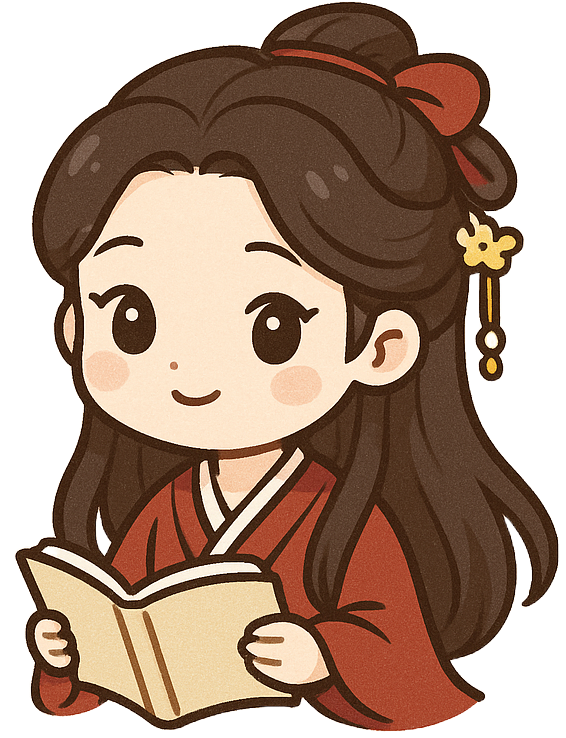
In the February weather, with grass growing and orioles flying, the vast mountain scenery veiled in clouds and mist gradually turned green under the warm breeze. The days Zhenzhen spent with Lin Hong also entered spring along with the season.
Lin Hong led Zhenzhen along the gurgling streams to explore the fragrant blossoms of mountain temples. Together, they admired apricot flowers blooming from crevices, savored the newly sprouted buds of mountain tea trees, gathered mushrooms in pine-shaded clearings, and dug up spring bamboo shoots in the lush, verdant bamboo groves. Lin Hong taught Zhenzhen to distinguish between peach, plum, apricot, and wild cherry blossoms from subtle details, sharing with her the origins and stories of the flora and fauna they encountered. Of course, he never forgot to mention the cooking techniques for seasonal spring delicacies.
"How would you prepare newly harvested bamboo shoots?" Lin Hong asked Zhenzhen.
After some thought, Zhenzhen replied, "Slice them, coat the slices with spices and batter, then pan-fry them in oil until golden and crispy—sweet and delightful. Or, as you once did, cut them into square pieces and cook them with rice into a porridge, white as jade, equally beautiful."
"Yes, those two methods—one like frying gold, the other like boiling jade—are both excellent. However, there is another way, extremely simple, that captures the true flavor of fresh bamboo shoots even better." Lin Hong glanced around the bamboo grove and pointed to a spot with fallen leaves. "Bamboo leaves fall easily. In a little while, there will be more withered leaves, enough to gather into a pile. Then, sweep the fallen leaves around the newly sprouted shoots, light a fire, and roast them right beside the bamboo. The sweetness and freshness achieved this way are unmatched by any other method. I call bamboo shoots prepared this way 'bamboo-side fresh.'"
Zhenzhen marveled, "The chefs I saw in my childhood were often praised for their skillful use of seasonings, and some even boasted about making vegetarian dishes taste like meat. Before coming here, I once thought your dishes would be heavily seasoned. I never expected most of your meals to be light, pursuing the true flavor of ingredients, with minimal seasoning. This 'bamboo-side fresh' not only uses no seasonings but even dispenses with pots, bowls, and utensils."
Lin Hong smiled faintly. "As long as ingredients are in season and fresh, even simple steaming or blanching will yield a delicious taste. Often, such dishes allow the seasonal aroma to shine more than heavily seasoned foods. Just like a sixteen-year-old girl, she needs no makeup or adornment—her natural face is lovely. Whether she laughs, speaks, frowns, or gets angry, she looks beautiful in every way."
Zhenzhen quickly calculated her age in her mind—she was still nearly a month away from turning seventeen. "So..." she cautiously asked Lin Hong, "perhaps, in your eyes, I am not so black and white?"
Lin Hong was taken aback, then chuckled softly. He didn’t answer Zhenzhen’s question. Instead, he turned and walked deeper into the mountains, stepping over a gently flowing stream. Looking back, he saw Zhenzhen still standing where she was, her gaze shifting uncertainly between his face and the stream. He extended his right hand to her. "Come."
Zhenzhen was utterly bewildered. She didn’t follow immediately, partly because she regretted her earlier question as too abrupt—fearing her teacher might find it lacking in restraint—and partly because she hesitated to cross the stream. The width of the stream seemed easy enough for her to leap over, but she worried that a sudden, vigorous jump might startle her teacher.
Now, she was almost startled by Lin Hong’s outstretched hand. That hand, with its long, slender fingers and clean, pale skin, was openly extended before her, palm upward, as if waiting for her to take it. It seemed her teacher intended to guide her across the stream.Several questions instantly swirled through Zhenzhen's mind: Wasn't he afraid of touching others? If he held my hand, would he break out in chills again? Should I extend my hand to him or not?
Lin Hong seemed to perceive her hesitation, or perhaps he thought she was constrained by propriety between men and women. He drew his sleeve over his right hand and then extended it to Zhenzhen as before.
So Zhenzhen walked to the stream's edge, lowered her head, and placed her right hand into Lin Hong's palm, which was covered by his sleeve. Feeling the warmth of his hand through the layer of fabric, she was led across as if floating on clouds, dazed and oblivious to how she actually crossed the stream.
Zhenzhen continued following Lin Hong as they explored the secluded beauty of the forest, feeling the mountain scenery had grown even more exquisite. The sky had just cleared after rain, and along the path, orioles chased one another. A gentle breeze rustled, brushing softly against their clothes. Walking behind Lin Hong, Zhenzhen let the shadow of his fluttering sleeves overlap with her own, maintaining her silence. Yet her lips curved into a smile, and her heart felt as if four or five sparrows were leaping within.
They arrived at a valley where plum blossoms fell like snow, their ice-silk petals drifting with the wind into the stream, carried away by the water. The stream was clear, murmuring as it flowed downward, its sound especially ethereal in the secluded valley, reminiscent of a konghou's melody. By the stream grew several clusters of emerald seedlings, their color like the fresh green of misty willows, with dewdrops still glistening on the leaves, making them appear even more vibrant and tender.
"This is water celery," Zhenzhen said, pointing at the green clusters.
Lin Hong nodded. "The Emerald Stream Broth I had you taste earlier was made with water celery from here."
"Was the name 'Emerald Stream Broth' also chosen by you, Teacher?" Zhenzhen asked.
Lin Hong replied, "This name comes from Du Fu's poem: 'Fresh crucian carp sliced like silver threads, fragrant celery in emerald stream broth,' depicting the fresh delicacies of spring in the mountains." Seeing Zhenzhen smile, he asked why. Zhenzhen then recounted her earlier dispute with Mussel Tower, mentioning how Zhao Huaiyu had taught them to make Emerald Stream Broth. "At the time, I thought Mussel Tower was merely pandering to the tribute scholars, using an elegant name to embellish ordinary vegetables. But coming here today and seeing this scenery, I now understand the origin of the name 'Emerald Stream Broth'—it truly fits perfectly."
Lin Hong said, "Boiling water celery with stream water creates a light and fragrant broth. Hearing the name 'Emerald Stream Broth' before tasting it brings the spring scenery of the valley to the tip of your tongue. So the name serves to highlight the essence, not merely as an embellishment."
Seeing Zhenzhen still pondering his words, Lin Hong asked her another question: "If you were to make cherry cheese in summer, arranging cherries over shaved ice and drizzling them with cheese and honey, and you had two containers to choose from—one a lacquer plate, the other a crystal plate—which would you pick?"
Zhenzhen answered, "Naturally, the crystal plate. Eating cherry cheese in summer is meant to relieve the heat. Serving it in a crystal plate, with the container itself resembling ice and snow, would make one feel even cooler."
Lin Hong smiled. "Exactly. In truth, neither the lacquer plate nor the crystal plate affects the taste of the cherry cheese, but their visual appeal differs, and so does the diner's experience. Dish names, like containers, aim to enhance perfection. They may not change the flavor of the dish, but they are not entirely useless either. As for the allusions involved, whether to mention them, and how to mention them, varies from person to person and from situation to situation. If done well, one can discuss the past and present, or offer advice and reasoning. If done poorly, or if spoken at the wrong time or to the wrong person, it will seem like mere pretentiousness."Zhenzhen found this deeply convincing. Lin Hong continued, "A dish that benefits both body and mind possesses beauty of essence; one with excellent flavor possesses beauty of taste; one exquisitely presented possesses beauty of form; one with an elegant name possesses beauty of name. When a dish encompasses all four beauties, it not only satisfies the eater's appetite but also soothes their aesthetic sensibilities, bringing them great delight. And when we cook, we should not merely see ourselves as kitchen workers. Pondering culinary arts, like burning incense or arranging flowers, is an affair related to beauty—it can nourish body and mind, temper one's will, and elevate one's cultivation."
Zhenzhen remained silent, thinking to herself that her master was an extraordinary man beyond worldly concerns, which was why he could regard culinary arts as an elegant pursuit akin to incense-burning or flower-arranging. Her mother and senior sisters, however, had honed their culinary skills to make a living in this mundane world. As for herself now, she saw cooking as a stepping stone into the palace, burdened with heavy responsibilities—how could she possibly approach it with his same detachment? Turning these thoughts over in her mind, she found herself at a loss for words, finally letting out a long sigh: "So difficult, so difficult."
Lin Hong seemed to sense what she was thinking and added, "You came to learn from me saying it was to make a living, but I always felt there was more to it. In the kitchen, you carry a vague anxiety; you focus on techniques, imitating me in every detail, yet lack reflection. Perhaps you have something very important that requires culinary skill to resolve. You need not tell me. I only hope that one day, after you have resolved your matter, you can set aside all utilitarian concerns and, with a light and joyful heart, prepare for yourself food that embodies all four beauties."
(To be continued)