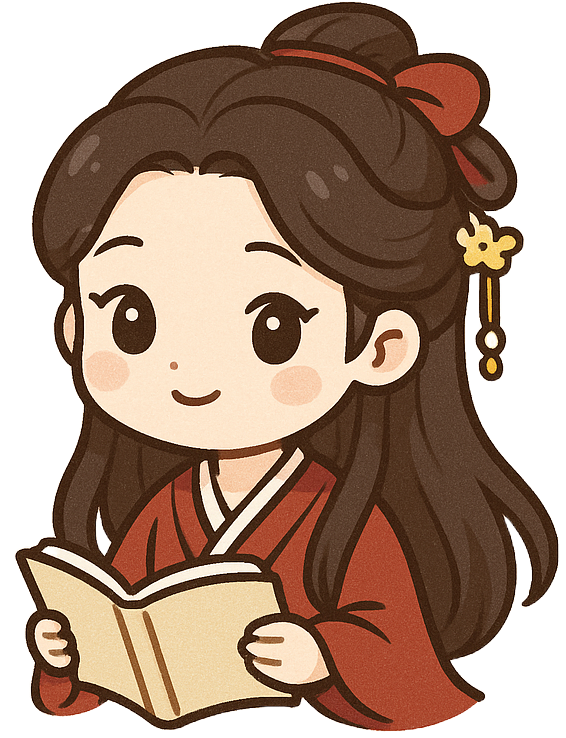
Their daily teaching and learning typically went like this: Lin Hong would first complete the dish he intended to make, with Zhenzhen observing and occasionally assisting. Then, Zhenzhen would select the day’s ingredients and prepare one or two dishes herself, while Lin Hong watched the entire process, promptly pointing out any mistakes or offering suggestions for improvement.

These "mistakes" were indeed quite numerous. Zhenzhen discovered that, in Lin Hong’s critical eyes, even the little donkey in the backyard seemed more skilled at cooking than she was. Almost from the moment she picked up the knife, she began making errors. Lin Hong, holding a red dogwood branch, would occasionally tap her on the spot where she went wrong: "Stand straight, don’t tilt your head, don’t arch your back, keep your feet shoulder-width apart, don’t hunch your shoulders, and don’t let them droop… Keep your abdomen no less than a fist’s distance from the cutting board… and no more than half a foot… What are you looking at? Don’t stare at your abdomen—look at the vegetables you’re cutting."

"Teacher," Zhenzhen couldn’t help but timidly ask, "how can I know how far my abdomen is from the cutting board if I don’t look?"

Lin Hong replied, "When you’re first learning, you can glance before you start cutting, but once the knife is in motion, don’t keep thinking about it. First, you must wield the knife according to proper technique, and then, in the process, find a rhythm that feels comfortable and effortless. Don’t treat cutting as labor—there’s a cadence to the rise and fall of the knife. Ingredients can be crisp, tough, soft, or hard, and the rhythm of the knife must adjust accordingly. As you follow these varying rhythms, extend your gestures as if playing an instrument. When you play well, you won’t stray from the technique, and your posture will naturally be graceful."

Zhenzhen carefully observed how Lin Hong held his knife and noticed that his grip was firm yet flexible, steady but not rigid. His demeanor was relaxed and composed, as leisurely as a stroll in a garden, and the ingredients he cut were uniformly and finely sliced, as elegant as his posture while working.

On rare occasions, Zhenzhen would also spot what seemed like a flaw, such as: "Teacher, your abdomen is now more than half a foot from the cutting board—that doesn’t follow the rules."

Without lifting his gaze, Lin Hong continued cutting the vegetables at his own unhurried pace. Only after showing Zhenzhen the still-perfect result did he respond: "When you practice to my level, you can disregard the rules… I am the rules."

Lin Hong’s study was tidy and elegant, with several stalks of emerald bamboo planted outside the window, their shadows swaying against the gauze curtains. Beneath the window stood a low table with a Go board, while on the other side, a writing desk held brushes, a brush rest, an inkstone, a water dropper, ink, and a paperweight. A small celadon incense burner was also placed there, perpetually burning either the fine sandalwood he selected or the incense he blended himself. Hanging on the wall was a painting he had created himself: a scene of a sunlit riverbank, peach trees in full bloom, winding paths shaded by willow trees, and a beautiful woman turning her head gracefully by the river. Her left hand stretched backward, adorned with a vibrant green bracelet. Her hair was piled high like clouds, and her sleeves fluttered as if about to take flight in the wind. Yet, her beautiful eyes glanced back with a look of reluctance.

Every day, Lin Hong would arrange flowers in a bronze square vase and place it before the painting. In his leisure moments, he often lingered there, gazing intently at the painting. Sometimes, he would clutch a piece of translucent green jade in his hand, his eyes shifting between the woman’s wrist in the painting and the jade stone.

Zhenzhen happened to catch a glimpse of this and couldn’t help but grow curious. She privately asked Xin Sanniang about the identity of the woman in Lin Hong’s painting. Xin Sanniang said, "Oh, that… that’s Lady Linshui, the Goddess of Childbirth."

Lady Linshui, also known as Chen Jinggu, is a Taoist deity worshipped in southern Fujian, revered for aiding women in difficult childbirth and bestowing children. But this answer greatly surprised Zhenzhen: "Teacher Lin has never married. Why would he worship the Goddess of Childbirth?"Xin Sanniang hesitated for a moment before saying, "Anyway, the young master will marry and have children sooner or later. It's better to keep it prepared, just in case."

This reason was rather far-fetched. Seeing that she clearly didn't want to explain further, Zhenzhen went to ask A Che. A Che also hesitated noticeably before finally giving a different answer: "The young master painted Luo Shen."

"Really?" Zhenzhen was skeptical.

This time, A Che nodded with certainty. "Of course it's true." He pointed at the woman in the painting. "Look at her posture—gliding over the waves, her silk stockings stirring the dust. Who else could it be but Luo Shen?"

Zhenzhen examined it carefully and felt this explanation was more reasonable than the Goddess of Childbirth. She then asked A Che, "Why does the teacher worship Luo Shen?"

A Che replied, "The young master is a talented scholar, just like Cao Zijian. Talented scholars surely admire Luo Shen... Perhaps, by worshipping her daily, Luo Shen will inspire his creativity?"

Seeing Zhenzhen still staring blankly at the portrait, he nudged her with his elbow. "You should go and pay your respects too. Ask Luo Shen to bless you so you won't be so clumsy and can master culinary skills sooner."

Zhenzhen glared at him, but after A Che left, she quietly bowed to the portrait and whispered a prayer: "Please, Sister Luo Shen, bless me to study smoothly at the Woodcutter Inquiry Post, enter the Bureau of Palace Provisions next year, and find my mother."

From then on, it became Zhenzhen's habit to bow to Sister Luo Shen every day and repeat the same wish. She also became more proactive in helping Lin Hong tidy his study. Noticing that the bronze square vase he used for flower arrangements was covered in red and green patina, with the interior almost completely coated in green rust, she thought to herself that since the teacher loved cleanliness, the vase must have become so rusty because A Che was lazy and hadn't cleaned it properly. So, while Lin Hong was out, she took the vase, scrubbed it repeatedly with vinegar until the exterior was quite shiny, then used a brush to remove the green rust from the inside, cleaning it thoroughly.

Thus, when Lin Hong returned, he was faced with an almost brand-new bronze vase. He turned to look at Zhenzhen, his face turning a shade of green as if he had been coated in rust.

Zhenzhen's eyes sparkled as she eagerly scanned his face, hoping to find traces of pleasant surprise. "Teacher, this vase... should I clean it some more?"

Lin Hong's emotions churned rapidly within him, but in the end, seeing the hopeful look in Zhenzhen's eyes, he suppressed the scolding that was about to burst forth and replied calmly, "No need to clean it anymore. This vase hasn't been this clean in a thousand years."

A Che, however, glared at Zhenzhen, about to reprimand her, but as soon as the word "you" left his lips, Lin Hong stopped him and ordered him to take the vase to the storeroom and bring another Ru kiln vase instead.

Zhenzhen was puzzled. "Teacher, don't you like that I cleaned the vase?"

"No," Lin Hong said gently. "It's just that I've used it for a long time and now I want to change it." Seeing Zhenzhen's smile fade as she continued to scrutinize his expression, he smiled faintly and instructed, "Go to the garden and cut a few branches of red plum blossoms for me to arrange in the vase."

The flower branches Lin Hong used for arrangements were usually cut and delivered by the gardener, which he would then trim and adjust before placing in the vase. Having received the order, Zhenzhen excitedly went to cut the red plum blossoms he loved most, carefully selecting each branch to ensure they were beautifully shaped and in full bloom before presenting them to Lin Hong for approval.

Lin Hong looked at the plum branches she had cut and said, "They are all very beautiful. However, such beautiful branches are better left growing on the tree. Don't cut them anymore in the future."He instructed A Che, who had just placed the Ru ware vase, to take the plum branches and arrange them in the large vase in the hall. Then he rose and led Zhenzhen into the garden, where he selected some damaged branches, withered branches, and leggy growth to trim.

Returning to the study, Zhenzhen stared at the branches she had never paid attention to, still puzzled as to how they could be used as an offering for Sister Luo Shen. But Lin Hong had already picked up a straight, leggy branch. Holding it close to his abdomen with both hands, his thumbs lightly touching, he applied a slight force. A faint, crisp sound came from the branch. Startled, Zhenzhen had yet to react when Lin Hong continued moving his hands along the branch. Several more crisp "crack" sounds followed. When he released his grip, the branch had been bent into an elegant curve, its bark almost undamaged, as if it had grown that way naturally.

"Although the inner wood is bent, the vessels remain unbroken. When placed in the vase, it can still absorb water, just like an unbent branch," Lin Hong explained.

Zhenzhen nodded. "I understand. It’s like breaking a bone but keeping the tendons connected."

Lin Hong smiled and handed her another leggy branch. "You try."

Zhenzhen took it and attempted to bend it. At first, her strength was insufficient, and the branch immediately sprang back to its original shape when she released it. Then she increased her force, but this time a sharp, crisp sound rang out—the branch snapped completely.

Embarrassed, she apologized to Lin Hong. He reassured her with a gentle smile, took another branch, and demonstrated while bending it. "Hold it with both hands, about a fist’s distance from your abdomen. Bend it slowly first to feel its flexibility, then choose the appropriate force. When bending, the movement should be clean and decisive. The sound must be crisp but as soft as a baby’s cough. If it’s sharp and piercing, it means it’s broken."

Zhenzhen suddenly understood. "It’s the same with cooking. Before handling ingredients, you must first understand their texture, then choose the appropriate force and cutting technique."

Lin Hong continued working on the remaining branches without speaking further. His eyes fixed on the chosen branch, he observed its original posture before confidently bending it into the desired curve. His expression was focused, yet he completed the task with remarkable ease.

This demeanor was truly beautiful, just like when he concentrated on painting, calligraphy, playing the qin, or tending to cranes. In that moment, she suddenly realized that a man is most beautiful when he is wholeheartedly engaged in something he excels at.

She silently watched Lin Hong, feeling as if bathed in warm spring sunlight, her heart filled with warmth. It wasn’t until Lin Hong noticed her unconscious smile and looked at her questioningly that she blushed and lowered her head.

"Any more questions?" Lin Hong asked.

Zhenzhen lowered her gaze and thought for a moment, then pointed to the withered branches. "Why choose withered branches? When we admire flower arrangements, aren’t we looking at the blooming flowers? Withered branches seem rather bleak."

Lin Hong didn’t answer immediately. Instead, he arranged the previously prepared branches in the vase and then selected a dry, vigorous branch without any leaves or flowers, inserting it diagonally at the back. Only then did he speak. "Why avoid withered branches? They represent the past we can learn from."

Zhenzhen looked up at the completed flower arrangement. In the vase, delicate branches in the front bore unopened buds, the central main branch was graceful and elegant with a blooming flower about half a foot from its tip, while the withered branch at the back was robust and rugged. Together, they formed a scene with varying density, where life and death, prosperity and decay, were all part of a unified whole—like a miniature painting of life.

(To be continued)