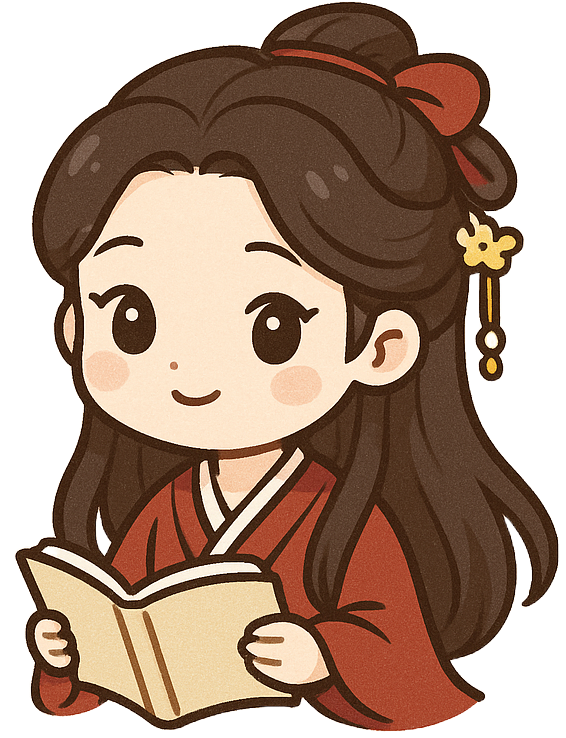
Zhenzhen felt her cheeks flush with heat, then realized that to refute the peasant woman, she must clarify the truth. So she recounted everything she had seen from when she fainted yesterday to when she awoke in the evening, describing in detail the furniture in the room, the shapes of the utensils, and even the chicken noodle soup and wintersweet tea.
The peasant woman seemed somewhat convinced after hearing this, but then said, "There are no houses or young masters like you described around here. However, spirits often cause trouble in the mountains—flowers, birds, beasts, and even rocks and soil can absorb the spiritual energy of heaven and earth and transform into human forms. Last year, on the Qixi Festival, my neighbor's fourth daughter bought a clay Moholo at the foot of the mountain—a chubby, fair-skinned boy wearing a gold bracelet, looking adorable. Fourth Daughter liked it very much and placed the Moholo by her bedside when she slept that night. That very night, a young master came knocking on her door, saying he had long admired her and wished to meet her. Fourth Daughter peeked through the window and saw the young master was exceptionally handsome, so she opened the door..."
Zhenzhen listened intently and, seeing the peasant woman pause, immediately asked, "And then?"
The peasant woman rolled her eyes. "And then? Let's just say they spent the night chatting under the covers."
Only then did Zhenzhen realize there were details unsuitable for elaboration. She covered her slightly flushed cheeks with her hands and chuckled silently.
"The young master left before dawn, but before he did, he gave Fourth Daughter a gold bracelet. The next day, when Fourth Daughter took out the gold bracelet, guess what happened?" The peasant woman narrated vividly, posing questions to guide Zhenzhen's thoughts, much like a storyteller.
Zhenzhen laughed. "She must have discovered the gold bracelet was made of clay."
Seeing her guess so quickly, the peasant woman was somewhat disappointed. She lowered her previously wide-open eyelids and continued, "Yes, she hurriedly looked at the Moholo by her bedside and noticed the bracelet on the doll's hand was gone. Only then did she realize the young master was the Moholo transformed."
"And then?" Zhenzhen pressed further.
The peasant woman said, "Fourth Daughter smashed the Moholo into pieces, and the young master never appeared again."
"Ah?" Zhenzhen was quite surprised. "She just smashed it like that?"
"Of course," the peasant woman frowned at her, thinking this girl was truly shameless. "If she didn't smash it, would you wait for him to visit you every night?"
Zhenzhen found it amusing yet felt a bit shy. She pushed aside the dry grass, hugged her knees, and buried her face in her sleeves to hide her uncontrollable smile. This movement allowed her to clearly smell the wisteria fragrance lingering on her sleeves. She recalled the incense burner on the small green-painted lotus leaf and remembered the crane's gaze before she fainted. Feeling somewhat dazed, she wondered: Could what she saw last night have been an illusion conjured by a crane spirit? The person from last night wore white robes with black trim, which indeed resembled the colors of a crane. But if it were an illusion, shouldn't the wisteria fragrance have dissipated? Why, then, did it cling to her clothes?
The peasant woman seemed to dislike Zhenzhen greatly. When Zhenzhen asked for her name, she didn't answer; when asked for directions to Woodcutter Inquiry Post, she claimed not to know. After sitting for a short while, she dug two roasted taro from the ashes of the firewood pile and tossed them to Zhenzhen, advising her that the mountain was cold, wild beasts roamed frequently, and it was quite dangerous—she should descend as soon as possible. Then, she left directly.
Zhenzhen stood up and surveyed her surroundings, realizing this cave was the very one she had seen before fainting. After resting for a moment, she gathered her belongings and the two taro, then continued her journey, heading up the mountain.It was early morning, the sky had just cleared after snow, and clouds and mist drifted among the peaks, with golden rays of sunlight spilling over the sea of clouds, creating a scene like an immortal realm. Zhenzhen had no mind to admire the view and continued climbing upward. After walking for a while, she felt hungry, so she took out a taro given to her by a peasant woman, peeled it, and began to eat. Seeing the valley was exceptionally quiet, she recalled the woman's words and secretly worried that a wild beast might suddenly leap out from somewhere in the forest. Not daring to stop, she ate as she walked.
Rounding a steep cliff, she suddenly heard the sound of a zither ahead. She didn’t recognize the tune, but the music felt long and expansive, blending with the wind through the pines in the valleys, like heavenly sounds or Buddhist chants that calmed and soothed the spirit.
Sensing human presence, Zhenzhen, with a mouthful of taro, now had no time to swallow it. She quickened her pace and hurried toward the source of the music.
Ahead, facing the valley, there was a small pavilion perched on a rock jutting out from the cliff. Inside the pavilion stood a zither table and an incense altar, with a small bronze Boshan censer emitting wisps of fragrant smoke. A scholar, draped in a cloak lined with snow-white marten fur, was playing the zither while facing the valley and the sea of clouds. Behind him stood a teenage page, silently attending.
Zhenzhen quietly approached the pavilion, moving to the scholar’s side to get a glimpse of his face. As the scholar paused in his playing, he slightly turned his head. At that moment, the golden-red morning light brushed against his plain white figure. With half-closed eyes and hands resting on the icy strings, even his profile alone was elegant and serene, as pure and divine as a deity.
Recognizing this person as the "crane spirit" she had seen the night before, Zhenzhen nearly cried out in surprise. As soon as she opened her mouth, she realized she still had taro in it. She forced herself to swallow, but in her haste, her chest tightened, and a strange sensation surged between her throat and chest, finally escaping her control and rushing up from her throat...
The result was a loud burp.
The zither music stopped abruptly. She covered her mouth, her other hand still clutching half a taro, utterly mortified under the calm gaze of the handsome crane spirit.
As she and the "crane spirit" stared at each other in a daze, she suddenly heard an angry shout from behind: "What are you doing here? Did you follow me to find my master?"
Zhenzhen turned around and saw that the person behind her was none other than the peasant woman she had encountered earlier. Now holding a piece of rabbit meat, the woman glared at her with fury.
Pondering the woman’s words, Zhenzhen guessed that she must be a servant in the "crane spirit’s" household. She then realized that the servant was likely displeased with her for staying in her master’s room the previous night, hence harboring ill will toward her. The servant had likely used the tale of a spirit transformation to confuse the truth, hoping Zhenzhen would stop seeking out the master.
Zhenzhen composed herself and sneered, "Don’t judge others by your own standards, thinking everyone values your master as much as you do. You may see him as a precious jewel, but in my eyes, he might not even be as important as this piece of taro." She deliberately raised the taro in her hand and said to the servant, "I have no mood yet to wipe away the cold tears, nor the time to keep company with vulgar people."This was a Zen saying that Pu Bo had shared with her during winter nights by the stove while roasting taro when she was a child. It told of a monk who served at Hengyue Temple during the Tang Dynasty. He was very lazy and often collected leftover food from other monks, so people called him "Lazy Remnant." Yet this Lazy Remnant monk was actually a master who understood Buddhist teachings and was well-versed in both ancient and contemporary knowledge. Lord Li Bi of Ye, hearing his Sanskrit chants echoing through the mountains and forests, concluded that he was no ordinary man and went to pay him a visit. The monk dug a taro out of a cow dung fire, ate half himself, and handed the other half to Li Bi. After Li Bi finished eating, Lazy Remnant instructed him, "Be careful not to speak too much, and you shall receive ten years as prime minister." Later, another nobleman went to invite him to leave the mountains, but the monk, while eating taro, said, "I haven't even the mood to wipe my cold runny nose, how could I have time to accompany a worldly man like you?" Meaning the taro was so delicious that he didn’t even have time to wipe his running nose, let alone spare any for a mundane person.
The servant woman didn’t understand this Zen saying and stared at her in astonishment, momentarily unsure how to respond. However, the "Crane Spirit" seemed to grasp it perfectly. He stood up and said gently to Zhenzhen, "So the young lady also knows of Master Lazy Remnant."
Zhenzhen gave a slight smile. "After all, I’ve studied for a few years. But I’m still just an ordinary person, likely unworthy of entering your Crane Spirit’s immortal realm, which is why you tossed me out in the middle of the night."
"Ah, you can’t blame my master for that," the servant woman hurriedly explained. "You were sleeping on the floor in his room like a crab, and I simply couldn’t bear to watch, so I moved you to the cave."
A crab? Moved? Just as Zhenzhen was about to flare up in anger and rebuke her, she heard the young master speak first. "San Niang, say no more for now." Then, turning to Zhenzhen, he said, "It was impolite of us to ask you to leave before you woke up, and we were wrong to do so. I hope you can forgive us. My humble home lies in the valley. If you don’t mind, please stay a while longer and join us for lunch before you depart."
Zhenzhen, still simmering with anger, was about to refuse outright. But with a glance at San Niang, she changed her mind: If I accept her master’s invitation and make her watch as he entertains me, wouldn’t that annoy her even more?
Instantly, her mood brightened, and she presented an elegant, magnanimous smile to the "Crane Spirit," indicating that she didn’t mind visiting.
Zhenzhen followed the "Crane Spirit" and his companions down the mountain from the other side of the cliff, arriving at his garden residence nestled in the valley. Along the way, she asked for his name. He said his surname was Lin and his given name was Hong—the "Hong" from "deep and clear, vast and boundless." Seeing Zhenzhen’s puzzled expression, he rephrased it: "The 'Hong' from 'a pool of autumn water, a wheel of moon.'" Though Zhenzhen had never heard this line of poetry, she understood "a pool of autumn water" and nodded in praise. "What a clear and pure name."
Lin Hong’s garden residence was situated by the water in the mountains. The garden was surrounded by thorny bushes, interspersed with bamboo over ten feet tall. Outside the fence grew taro and chestnut trees, while inside, several layers of plum blossoms were planted. Entering the garden, Zhenzhen saw a pond in front of the house, so clear that the bottom was visible. On one side of the pond, rocks were piled up to form a small hill, with spring water flowing down from the rocks, tinkling like jade pendants as it cascaded into the pond.
In the pond was a small island, on which stood a crane house made of bamboo. Two red-crowned cranes were playing by the water’s edge and, upon seeing Lin Hong arrive, spread their wings and danced. The garden, with its flowers and bamboo interwoven, birds singing and cranes calling, felt even more like a mountain forest.
The residence consisted of two courtyards. The front courtyard had four or five rooms, where Lin Hong lived, stored his books, and blended incense. The rear courtyard housed the kitchen, wine cellar, and the quarters for the servant women, page boys, and gardeners.Lin Hong invited Zhenzhen to sit in the main hall of the front courtyard to rest for a while, then promptly left. After some time, San Niang entered, expressionlessly setting up the table. She placed a large tin tray on the table, filled it with water for insulation, and then set a small red clay tripod brazier used for boiling water on the tray. On the brazier, she placed a copper pot, removed the lid, revealing half a pot of boiling water inside.
Soon after, San Niang brought several small dishes of condiments—soy sauce, vinegar, orange paste, scallions, and the like. After a short while, she presented a large plate of thinly sliced meat, as thin as fish slices, arranged in clusters resembling flower petals on the plate, with alternating red and white hues that looked quite appealing.
Zhenzhen asked what kind of meat it was. San Niang replied, "Wild rabbit meat. My son caught it while hunting today. I originally intended it for the young master, but he said he wouldn’t eat meat these days, so you’re in luck."
Zhenzhen then asked why the young master was not present. San Niang said, "He never eats with others. He always dines alone in his own room."
San Niang placed the bowls and dishes in front of Zhenzhen. Seeing the water in the pot was boiling, she handed her chopsticks and gestured for her to take the condiments and dip the meat into the pot. This way of eating was entirely new to Zhenzhen. She asked San Niang how long the meat should be cooked. San Niang replied, "Just dip it in the water and swirl it around a few times. Once the color changes, it’s ready to eat."
Zhenzhen followed her instructions. The boiling water in the pot churned like white waves on a river, while the bright red meat slices, when dipped into the water, resembled flowing evening clouds, their colors gradually fading in a mesmerizing display.
Zhenzhen first tasted the meat without dipping it in any condiments. It had a savory and fragrant flavor. She asked San Niang if the meat had been marinated beforehand with wine, soy sauce, and Sichuan peppercorns. San Niang nodded silently and said, "You’re quite discerning for a young girl, able to detect these flavors."
Zhenzhen smiled and earnestly invited San Niang to join her. After some initial refusal, San Niang eventually sat down at Zhenzhen’s insistence. Together, they took condiments and enjoyed dipping the rabbit meat slices, eating heartily.
In high spirits, San Niang voluntarily told Zhenzhen that the young master had given this hotpot dish a beautiful name: "Cloud-Skimming Hotpot." Upon further inquiry, Zhenzhen learned that Lin Hong was skilled in culinary arts, preparing his own meals daily and often innovating. She praised, "Your young master’s residence is elegant and immaculate in every way. I never expected him to be so adept in the kitchen. His future wife will surely have much less to worry about."
San Niang said, "Indeed. My young master comes from a distinguished family, is handsome, knowledgeable, and skilled in cooking. Countless young women wish to marry him. Day after day, some women come by, lingering around him. When he ignores them, they even fabricate stories to try and trick him into taking them in."
Zhenzhen asked what kind of stories they fabricated. San Niang told her, "Usually, it’s something like their family has fallen on hard times, they’ve lost their parents, have nowhere to go, are penniless, and want to learn from the master."
In an instant, Zhenzhen understood why San Niang disliked her—she feared Zhenzhen was also there to deceive Lin Hong into taking her in. She thought to herself that someone like her, who genuinely had lost her family and was separated from her parents, would not be swayed by appearances and forget her original purpose. No matter how remarkable Lin Hong was, he could not detain her from her quest to find Mr. Wenqiao... Referring to Mr. Wenqiao as "teacher" was Pu Bo’s suggestion. He said that people often called venerable old Zen masters "teacher." Since Mr. Wenqiao lived in the mountains, he clearly resembled an old Zen master. Merely calling him "Mr." would not convey the proper respect, so when Zhenzhen met him, she should address him as "teacher."To clear herself in front of San Niang, Zhenzhen echoed her disdain for those women who fabricated their backgrounds, saying, "These women, in their pursuit of the young master, have even cast aside all sense of dignity. How can they face their parents' teachings with such lies? They truly disgrace us girls!"
San Niang was thoroughly pleased to hear this and went to fetch fruits, pastries, and sweet-as-honey rice wine. She drank and chatted merrily with Zhenzhen, enjoying a harmonious atmosphere. She also mentioned that her surname was Xin, and Zhenzhen could call her Xin Sanniang or Xin Sanjie.
The lunch lasted for an hour and a half. Seeing that it was getting late, Zhenzhen stood up to take her leave. Xin Sanniang asked her to wait a moment, washed the cups and utensils she had used, and stuffed them into her hands along with the ones from the chicken soup and flower tea she had drunk the night before, telling her to take them away.
Seeing that the cups and utensils were of excellent quality and far from ordinary, Zhenzhen declined, saying, "How can I accept this? I’ve already eaten and now I’m taking things too..."
Xin Sanniang waved her hand dismissively. "It’s fine, take them all. Anyway, the young master won’t want them after you’ve used them."
Xin Sanniang escorted Zhenzhen to the garden gate. As Zhenzhen bid her farewell and was about to leave, she suddenly noticed a small wooden plaque hanging on one side of the gate, inscribed with three characters: Woodcutter Inquiry Post.
The plaque was so small that she hadn’t noticed it when she entered, as her attention had been entirely on the scenery inside the garden. Now, seeing it, she was startled and hurriedly asked Xin Sanniang, "Is this garden called Woodcutter Inquiry Post?"
Xin Sanniang confirmed it. Zhenzhen’s smile froze in the wind. "So, Young Master Lin is Mr. Wenqiao?"
"That’s right," Xin Sanniang said. "This place is called Woodcutter Inquiry Post, so people in the mountains call him Mr. Wenqiao."
Feeling awkward, Zhenzhen lowered her voice and asked, "May I go back and see Mr. Wenqiao again?"
Returning to see Lin Hong, Zhenzhen bowed her head and presented Zhao Huaiyu’s letter to him. Lin Hong took out the letter and read it, then silently studied her for a moment.
Feeling guilty, Zhenzhen asked, "What did Young Master Zhao’s letter say?"
Lin Hong slowly unfolded the letter and held it before her eyes. "He said that you lost your father at a young age, are now separated from your mother, have experienced upheaval at home, have nowhere to go, and have little money. He hopes I can take you in and allow you to learn skills here... Is that correct?"
"Yes, that’s right," Zhenzhen replied, forcing herself to remain calm and pretending not to notice the burning anger in Xin Sanniang’s eyes. She tried to offer Lin Hong an awkward yet innocent smile. "Teacher Lin."
(To be continued)