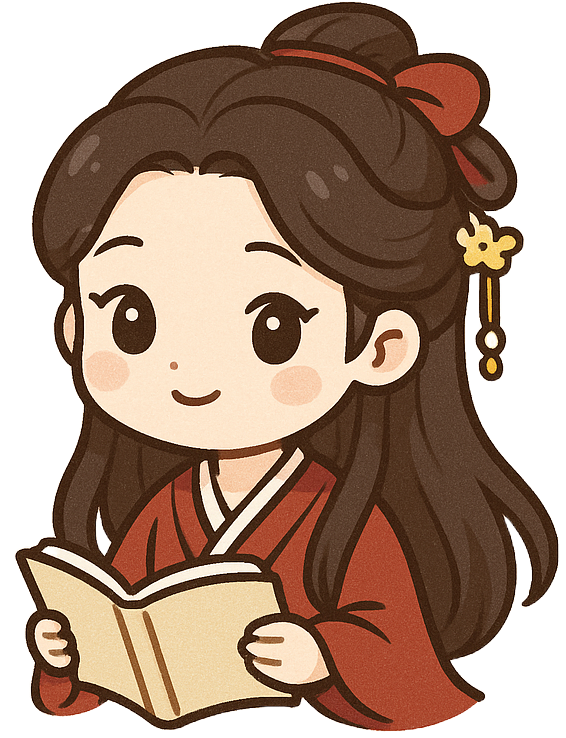
By the lotus pond on the eastern side of the Sheng residence, the day was fading into evening. While the rooms were stuffy, the courtyard enjoyed a cool breeze. Several young maids were chatting idly in the yard, cracking melon seeds, with not a single one left inside to attend to duties. Yao Yiyi lay alone on the beechwood canopy bed in the inner chamber, listlessly lost in thought, half-dead to the world.

Yao Yiyi buried her small, fleshy body among the pillows, her short limbs splayed out in a starfish shape, her expression vacant and dispirited. Ever since arriving in this world, she had been in this detached, ghost-like state. She turned her little head, surveying the room—it resembled an ancient chamber she’d seen on television. In the center stood a round Ruyi table, whose wood Yao Yiyi couldn’t identify, though its glossy, bright finish clearly indicated quality. Against the wall leaned a carved wooden cabinet, its patterns faintly depicting the Eight Immortals Crossing the Sea, along with a few low tables and round or square stools.

Feeling parched, Yao Yiyi slipped off the bed barefoot. Southerners often used wooden flooring, so the boards felt neither cold nor uncomfortable under her bare feet. Approaching the Ruyi table, she noticed a small stool and a slightly taller round stool beneath it. Amused, she stepped onto the small stool, then climbed onto the round one, steadily reaching the tabletop. She dragged over a heavy teapot and gulped directly from its spout.

After drinking, she retraced her steps back to the bed and suddenly noticed a lingering fragrance in her mouth. Dull-minded, she realized, "Oh, it wasn’t plain water today—it’s tea, and seems like good tea at that."

A few days earlier, she had also woken up thirsty and climbed to drink, when several people entered abruptly. The leading elderly matron, upon seeing her scaling the table to drink, looked as if struck by lightning, deeply shocked and distraught. She immediately reprimanded the maids and older servants in the courtyard, then comforted Yao Yiyi with kind words. At that time, Yao Yiyi had only been in this new world for a couple of days and was far from adjusted. She hadn’t yet encountered the expected father, mother, wet nurse, or personal maid; instead, a stream of people came and went like a revolving lantern, their faces still unfamiliar. So, she could only listen and watch woodenly, without any reaction. The old matron sighed, muttered "poor child" a few times, and left.

Yao Yiyi belatedly realized she’d been pitied. In truth, she wanted to say that having no one in the room suited her better. As an imposter, pretending to be calm and composed while still shaken was... rather difficult.

Alone in the room, she could stretch her legs as she pleased or sprawl like a frog, which actually helped her emotional recovery in the early days after her transmigration. After the old matron’s visit, the maids and servants promptly improved their service, leaving snacks and food on the table, keeping the teapot filled with tea, and yesterday, even placing a bowl of fresh, dewy grapes. More thoughtfully, they arranged stools and blocks of varying heights according to Yao Yiyi’s size, forming a stepped setup to ease her climbing up and down—then, they went out to play again.

Yao Yiyi was deeply touched.In the courtyard outside, voices chattered incessantly. Yao Yiyi didn't need to strain her ears to hear every word clearly. These past few days, the Sheng residence had been turbulent with activity. Even the maids in this quiet little courtyard had perked up, throwing themselves into gossip with fervor.

"This morning, I heard from Laifu, who serves the master, that an Imperial Edict came down the day before yesterday. Our master has been promoted to Prefect and will set off for Dengzhou at the end of the month. Consort Lin's place has been in chaos lately—she's rushing to liquidate some shops so she can take the money with her," said Maid A.

"My goodness! How much savings do you think Consort Lin has accumulated over the years? I've always thought she carried herself more grandly than the mistress herself. They say she comes from a noble family and lowered herself to become a concubine out of admiration for our master. It seems there's truth to that," Maid B exclaimed excitedly.

"Pah! Don't believe that nonsense from those bootlickers! My mother told me long ago that Consort Lin was just an orphan from a fallen official's family. When she first arrived at our Sheng residence, she only brought one young maid and an old nanny, with no more than five or six trunks and bundles in total. Her clothes weren't even as fine as those of the first or second-rank maids in the residence. What savings could she possibly have had?!" Maid C retorted indignantly.

"Ah, but Consort Lin is quite wealthy now. The master dotes on her so—no wonder the mistress is always upset. He even shows favoritism toward Feng Ge'er and Miss Mo. Consort Lin truly has skills," Maid D said enviously.

Maid E chimed in, "Of course! Otherwise, how could she have won the master's affection to the point where he disregards the mistress's dignity and the household rules? Old Madam isn't pleased either, but she can't be bothered to intervene. And Consort Lin has been blessed with both a son and a daughter—naturally, she stands tall. Ah, but it seems our courtyard is on the decline. When Consort Wei was here, things were better—the master visited often. But now that she's gone, it's become so desolate. Who knows where we sisters will end up? If only we could transfer to Consort Lin's side—they say the maids there get better food, clothing, and monthly allowances than anywhere else."

"You silly girl, you're dreaming! Let me tell you, Consort Lin is no easy mistress to serve," Yao Yiyi recognized Maid C's voice again as she spoke coldly. "When she first married in, she seemed fine. But after giving birth to Feng Ge'er, she subtly pushed out all the experienced maids and nannies. My mother, Nanny Lai, Cuixi's sister, and her old mother—do you know why? Because they had witnessed her destitute and shabby past!"

"Ah! Is that true, sister? Is Consort Lin really that formidable?" The eager Maid E was astonished.

"If I'm lying, may my tongue rot!" Maid C spat bitterly. "And now it's perfect—the respectable nannies won't talk, and those who would speak have been dismissed from the residence. No one in the household dares mention her past. Only those black-hearted ones who've benefited from her spread praises far and wide—how she's accomplished in music, chess, calligraphy, and painting; how she excels at poetry and songs; how kind-hearted and honest she is. Pah! The truly kind and honest one just died—our utterly guileless Consort Wei!"

"Sister Cui, keep your voice down! If you're overheard, you'll be in trouble!" Maid F warned kindly."Hmph! What am I afraid of? I'm already betrothed, and my mother serves Old Madam. She left the estate long ago to work at the manor. The day before yesterday, my parents begged a favor from Old Madam—when the master gets promoted and moves to Dengzhou, I won't be following. I'll stay at the manor to help with chores, and finally be free of all these wretched affairs."

So maid Cui C had already secured an escape route—no wonder she was so fearless, Yao Yiyi thought.

"Sigh, if not for Consort Wei's incident, who would've known Consort Lin could be so cruel? She always speaks so gently and politely, treats everyone with kindness—who could've imagined? Right after our Consort Wei died, she drove away Sister Die and the others, even dismissed our young lady's wet nurse, leaving only us clueless third-class maids..." Maid A's voice grew softer as she spoke.

"Those few were Consort Wei's most capable attendants and closest confidantes. Of course they had to be driven out. Otherwise, when the master investigates and asks questions, what if some clues are discovered?" Maid Cui C said.

"What clues? What nonsense are you spouting now?" Maid B whispered.

Maid Cui C lowered her voice: "Hmph! We may be third-class maids, but we're not blind. When Consort Wei went into labor that day, she started feeling pains at 3:15 am. Sister Die urgently went to Consort Lin to request a midwife—so why did the midwife delay until nearly 9 am? There are plenty of experienced childbirth attendants among the manor's matrons—what a coincidence they were all on leave those few days. When Consort Wei was at her limit, Sister Die desperately needed clean cloth and hot water, but why were we either sent to fetch people or run errands? At the critical moment, not a single useful person remained in the courtyard. Remember—the master and madam had left days earlier, Old Madam in the west courtyard doesn't handle affairs, and every matter in the estate was under Consort Lin's control. What clues do you think? Heaven has eyes—the master returned early due to official business, just in time to witness Consort Wei's last breath. After questioning Sister Die briefly, he flew into a rage. Had he returned a few days later, Consort Lin would have tidied everything up, leaving no evidence!"

After these words, the courtyard fell silent except for a few long sighs. Classmate Yao Yiyi gently exhaled, shifted her position, and waited for the next part. After a while, another maid spoke: "But these past ten-plus days, I haven't seen the master take action? He's just moved into the study, and Consort Lin remains untouched. In the master's heart, Consort Lin naturally holds more weight than Consort Wei."

Maid Cui C gave a short, cold laugh and said no more.

"If you ask me, why did Consort Lin even need to compete with Consort Wei? How could Consort Wei compare to her? She could've just ignored her like she does with Concubine Ping and Concubine Xiang," Maid D sighed.

"That's what you don't understand—how could Concubine Ping and Concubine Xiang compare to our Consort Wei? Though she didn't know poetry or painting, she wasn't some lowly maid either. She was properly carried through the doors in a sedan chair. Moreover, our Consort Wei was extremely beautiful, young and considerate. Since entering the household, she received much of the master's favor. She'd already borne a young lady—if she'd given birth to a son, she might not have been inferior to Consort Lin. What a pity..." Maid F spoke with the tone of someone who'd seen it all."Exactly. I heard he was an extremely handsome boy, with features exactly like the master's. How pitiful, to be suffocated right in his mother's womb... Oh, what a wicked crime." Maid B said in a very soft voice, "Even if the truth comes out, what then? Would the master really make Consort Lin pay with her life? For Feng Ge'er and Miss Mo's sake, he can't do much. He'll just take it out on a few servants."

The courtyard fell quiet again. Yao Yiyi nodded—this maid was sharp and had hit the nail on the head.

"Sister Cui, you're the lucky one. Your parents and brothers are all capable. Once you leave the mansion, you'll have a blessed life. But who knows where the rest of us will end up? It seems this little courtyard is about to disband, and I wonder where our mistress will go." Maid E never forgot employment concerns.

"What blessed life? It's just changing places to work, but at least I'll be closer to my parents and brothers and can enjoy some family happiness. Don't you worry either—you're all third-rank maids. Even if Consort Lin vents her anger, it won't reach us. We'll just serve a different master." Maid C spoke not without pride.

"A different master—who knows if they'll be as easygoing as Consort Wei? She's a kind person, never once scowled at us. That year when my younger sister fell ill, she even rewarded me with a few taels of silver." Maid A said.

"Kind she may be, but she's too timid. There's no decorum in our quarters—anyone can come and go as they please. Even the old women and stewards' wives in the courtyard dare scheme against her behind her back. She just endures it all, but it hasn't done her any good. Aside from Sister Die, who would dare stand up for her? Who remembers her kindness? I say, as a mistress, one ought to carry oneself with some authority. Trying to please everyone only shows a lack of discernment." Maid B remarked.

These topics were too heavy, and soon the maids shifted their focus to young Cui's marriage prospects, lightening the atmosphere in the courtyard once more. Yao Yiyi lay on her back on the bed, staring blankly at the green vine-patterned canopy on the carved frame. She had been listening to these fragmented conversations for over ten days. Currently, she inhabited the body of the Sheng family's sixth young miss, named Sheng Minglan.

A concubine-born young lady with no one to rely on, now seemingly addled from fever—dazed and unable to speak—was naturally disregarded by the servants. Coupled with the recent chaos in the Sheng residence, everyone was either busy moving or sorting silver. The old nannies and steward wives were run off their feet, leaving no one to supervise these young maids. Most of them were born into servant families—young in age but well-versed in household gossip. As third-rank maids with lax discipline, they chatted freely without restraint, which worked to Yao Yiyi's advantage. For over ten days, it was like listening to a serial drama, filling her ears with all the trivial affairs of the Sheng household.

Sheng Minglan's biological father, also the head of the Sheng family, was named Sheng Hong. A twice-listed imperial scholar, he currently held a sixth-rank official position and was about to be promoted to Prefect of Dengzhou. Originally born of a concubine himself, the Old Madam in the western courtyard was his legal mother. He had one wife and several concubines—don't ask Yao Yiyi how many, as the young maids told their stories too disjointedly for her to follow clearly.First, let's talk about the wife. The official wife of the Sheng residence, Madam Wang, was originally the daughter of the Left Vice Minister of Revenue. This marriage was considered a step up for Sheng Hong, as the Wang family was a long-established official lineage, while the old master of the Sheng family—Sheng Hong's father—had already passed away, leaving Sheng Hong as nothing more than a low-ranking scholar. However, this wasn't an issue, for Old Mrs. Sheng was there. Her background was even more prestigious than the Wang family's—she was the legitimate eldest daughter of the Marquis of Yongyi. Moreover, the deceased old master had once been a renowned Tanhua (third-place scholar in imperial examinations), celebrated throughout the land. After much head-scratching deliberation, the Wang family's old master finally agreed to the marriage.

After the wedding, Madam Wang gave birth to their eldest daughter, Miss Sheng Hualan, who had just reached marriageable age; their eldest son, Mr. Sheng Changbai, who was around the age of graduating from elementary school; and a younger daughter, Sheng Rulan, who seemed to be about the same age as Yao Yiyi's current body.

Now, let's discuss the concubines. The first to mention is, of course, the renowned Consort Lin (applause and cheers, please!). Though she shares the surname Lin, she was far more capable than the frail Sister Daiyu—their abilities weren't even in the same league, akin to the gap between Ye Yuqing and Wang Zuxian. Sister Daiyu, despite having her grandmother's protection and her father's wealth, ended up with a tragic, early demise. But look at Consort Lin: she entered the Sheng residence in humble circumstances, started from scratch, and transformed her oppressed, semi-feudal, semi-colonial existence into a preliminary developed state, successfully completing the transition from utter poverty to moderate prosperity. Her achievements were even more astonishing than the results of reform and opening-up. This Madam Lin bore a son and a daughter, Mr. Sheng Changfeng and Miss Sheng Molan, whose exact ages are unknown but likely fall between Sheng Changbai and Sheng Rulan.

There also seemed to be a Concubine Ping and a Concubine Xiang, with the latter having a son named Sheng Changdong, though his age remains unclear. As for other childless concubines, Yao Yiyi had no knowledge of them. Please don't blame Yao Yiyi for her lackadaisical transmigration attitude—her crossing had been rather unfortunate indeed.

Have you seen the Hong Kong TV series "File of Justice"? The verbal sparring, the back-and-forth, the love and hatred—what a challenging workplace! See that beautiful woman in the lawyer's robe? No, no, Yao Yiyi wasn't that lawyer. See that upright judge in front of the lawyer? No, no, Yao Yiyi wasn't qualified for that either. Please shift your gaze downward, to the right of the judge, where a guy is buried in typing and writing. Yes, Yao Yiyi was a glorious court clerk in the people's court.

After graduating from XX University of Political Science and Law, Yao Yiyi took the civil service exam, fought through fierce competition, and successfully secured a position in a local court near her home. This iron rice bowl made her close female classmates envious. The court consisted of the Case Filing Division, Criminal Division, Civil Division, Adjudication Supervision Division, and Enforcement Bureau. Yao Yiyi was fortunate to be selected by an old madam who was enthusiastic about forming an all-female team and was assigned to the busiest Civil Division as a clerk.

Court work was entirely different from what was portrayed in Hong Kong dramas. Yao Yiyi didn't need to speak or make judgments during trials; aside from continuously recording evidence, she was practically invisible. However, her name would eventually appear on the final verdict. Most of the cases she handled involved dividing family property and disputing inheritances, which aged her young heart with worldly sorrows.However, Yao Yiyi occasionally encountered a handsome lawyer brother and a prosecutor brother with great charisma. Unfortunately, standing beside the imposing and beautiful female lawyer, Yao Yiyi had no chance to shine. So, on the day she learned that both brothers had girlfriends, Yao Yiyi—her spirit elevated—bravely told the elderly female judge that she was willing to accompany her for a year of volunteer work in the border regions.

There was something called the "Mobile Court." For impoverished mountainous areas, transportation was extremely inconvenient. A trip to the city could take several days or even a week. If plaintiffs lacked the perseverance of someone like Ms. Qiu Ju, they would often prefer to settle disputes amicably. Thus, the "Mobile Court" was established. In the early days, dedicated judges would lead a team, leading horses or mules, carrying necessary documents, seals, and other supplies, trekking through villages and hills to places inaccessible by vehicles. They would hold court locally according to the summons. In short, it was a grueling task. Local courts were often short-staffed, so they needed support from courts in neighboring cities.

Yao Yiyi's superior, the elderly female judge, was just one step away from being promoted to a deputy department-level position. Determined, she gritted her teeth and decided to go. However, none of the other young women in the unit were willing. Those without boyfriends were busy searching for one, and those with boyfriends were busy keeping an eye on them. No one wanted to go. At this moment, Yao Yiyi stepped forward, and the elderly judge was moved to tears.

Upon hearing her daughter's decision, Yao's mother—who had served as the director of the Women's Federation for over a decade—immediately wanted to drag her daughter to the hospital for a brain check. Yao's capable older brother, who was building his career in the big city, roared over the phone. Only Yao's father, a government employee with lofty ideals, felt that his daughter was full of ambition and morality. After carefully analyzing the pros and cons of volunteering in the border regions, Yao's mother gradually calmed down.

In truth, Yao Yiyi wasn't motivated by the potential promotion opportunity after a year. She simply felt that her life had been too rigid, strictly following the state-mandated plan: elementary school, middle school, university, then work, and eventually marriage and children. Her entire life had been spent in a step-by-step environment. While comfortable, it lacked essential life experiences. She hoped to travel to different places, see and learn about people living in worlds different from her own.

A year later, after enduring countless hardships, Yao Yiyi was filled with satisfaction and pride, finally ready to return to the city. However, the area was suddenly hit by continuous heavy rain. On the first clear day, the elderly judge hurriedly gathered the team and set off in a minivan. Along the way, they encountered a damn mudslide.

Lying in bed, Yao Yiyi—now in a different "shell"—could only think: Protecting forests is everyone's responsibility. Indiscriminate logging leads to the end of one's lineage.

※※※

※※※

[Author's Note]When it comes to language, whether reading Dream of the Red Chamber or other vernacular novels, one will encounter a linguistic variety known as "Mandarin." At that time, standard Mandarin had not yet been widely promoted. So how did officials from all corners of the empire communicate after assuming their posts? For example, in my university dormitory, there were eight sisters from various regions. Among them, the Wenzhou dialect, Hunan dialect, and Quzhou dialect were utterly incomprehensible to me, even if my life depended on it. Comrade Hai Rui was from Hainan, and it is said that the Hainan dialect is no easier to understand than Javanese. So how did his superiors and colleagues cope? Did they resort to sign language? To address this difficulty, the precursor to standard Mandarin, known as "Mandarin," gradually emerged.

In ancient China, political centers were mostly located in the north (with the exception of the Southern Song Dynasty). Particularly during the Ming and Qing dynasties, the capital was situated in the northern region. As a result, a common official language, later referred to as "Mandarin," was developed based on the Beijing dialect, incorporating elements from other easily understandable dialects. To become an official, one had to learn to speak Mandarin first.

Initially, Mandarin was only spoken by officials. Later, women began using it in social interactions, and subsequently, servants in official households and distinguished gentry families were also required to speak Mandarin to serve their masters more conveniently.

When reading vernacular novels, we find that wealthy families would train newly purchased young maids and servants before putting them to work. An essential part of this training was speech.

For instance, Cao Xueqin's family held the position of Commissioner of Imperial Textiles in Jiangning for several decades, and the entire household lived in the Jiangnan region for just as long. Yet, the Cao residence still used Beijing-accented Mandarin and did not bother to learn the melodious Wu dialect. Therefore, no matter where an official was transferred—be it Shandong or Quanzhou—the women in the inner quarters spoke in a largely similar manner.

For us modern people, this language is understandable but not necessarily spoken fluently.

(Approximately so, please do not scrutinize too deeply. If you must scrutinize, do so calmly.)