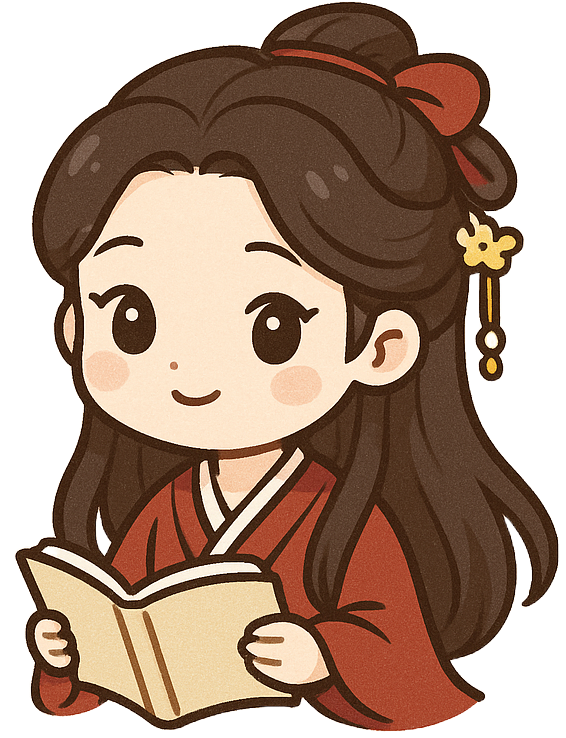
If Chen Huan'er were to self-evaluate her not-so-lengthy life thus far, she would likely choose these two words—chasing.
From the moment she took her first breath, she began racing against death, chasing health even before she was conscious enough to understand it. Fortunately, fate wasn’t entirely cruel—while it brought misfortune, it also granted her incomparably wonderful parents, the best mom and dad in the world. They named her Huan'er, and with their sincere, devout hopes, Chen Huan'er fought through that ordeal with sheer will and endurance—she outran death and never looked back.
Later, she was thrown into the torrent of Tianhe, where the outstanding were as numerous as hairs on an ox and unanswered questions as countless as stars in the sky. She was like an ant beneath an elephant’s foot, with no choice but to grow accustomed to chasing. Chasing others became a forced selection in the vast natural world—survival of the fittest, endure hardships to rise or fall. She gritted her teeth, step by step, overtaking many along the way, until she finally became a Chen Huan'er who began to shine.
Adults often say that habits become second nature, and now, Chen Huan'er had grown accustomed to her fate of perpetual chasing. She equipped herself with a salve for bruises and strains—if an experiment failed, she’d do it again; if data was flawed, she’d recalculate; if a report hit a dead end, she’d comb through literature and refine her thoughts, burning the midnight oil until she conquered it. Faced with the towering mountain of academia, she couldn’t even tell whether she was chasing the summit or herself. The only thing to do was keep climbing—precisely because she didn’t know, she had to press on with the belief that she could make it.
She met a great mentor, Ding Heping, though he was a bit eccentric—cheerful, he could talk for two hours straight; in a bad mood, he’d refuse to see anyone all day. When he was around, no one in the group was allowed to wear high heels because the sound of footsteps would severely disrupt his train of thought. Reports and papers, down to their formatting and even punctuation, had to meet his exacting standards—the slightest error meant an instant rejection. Yet Huan'er only saw the incisive revision notes in the emails he sent back at 2 a.m. and the groundbreaking, data-rich academic papers he published in renowned journals. Everyone said Ding Heping was a strange old man, but under such a mentor, Chen Huan'er thrived like a fish in water.
In early April, Chen Huan'er was called in for a talk. Ding Heping cut straight to the point: "Have you considered switching to a Ph.D.? Still in my group."
Huan'er was caught off guard and blurted, "So sudden?"
This made Ding Heping laugh. "Your academic performance is solid, and your progress over the past two years speaks for itself. The paper from the project you worked on is almost ready for publication. There’s no shady business here—authorship is based purely on contribution. You’ll be listed as a co-author."
Huan'er finally processed it—a direct Ph.D. track. A new option had suddenly appeared before her.
It was unexpected, yet not entirely so. As a student at the same university, she had joined the research group right after securing her master's spot, working on projects with senior students. Her senior year of undergrad had essentially been her first year of grad school, with her thesis topic decided before she even officially enrolled. By that measure, she was indeed ahead of the curve—but she had been so consumed by whether experiments would succeed or reports would pass muster that she’d never given further studies a thought.
"I’ve always believed that anyone in research must have a bit of obsession," Ding Heping said, looking at her. "Huan'er, you’ve got focus. No restlessness. You’re good material."
This left Huan'er utterly stunned. The nitpicking old man Ding was actually sparing no praise?
For her?
She asked, "Did you get assigned a recruitment quota or something?""There's no quota, but the shortage of hands is real." Ding Heping waved his hand helplessly, his tone suddenly emotional. "The school issued the official notice in early May, and you're the first person I've called in. Pharmacology and pharmacy, on a small scale, are about scientific innovation; on a grand scale, they're a mission for all humanity. I hope you'll consider this carefully, as it's a path that's both monotonous and lonely—a crossroads in your life."
Perhaps moved by Ding Heping's earnest words, Huan'er nodded firmly. "I'll think it over."
"Alright, that's all I wanted to discuss."
Huan'er thanked him and turned toward the door.
Before opening it, she turned back. "Do you really think I'm suited for a Ph.D.?"
"Yes," Ding Heping smiled. "I've told lies to my superiors, but never to my students."
Huan'er smiled too. "I'll keep your secret."
That evening, Chen Huan'er initiated a group voice call with her family. Chen Ba and Chen Ma joined quickly, and she recounted her conversation with Professor Ding in detail. After she finished, there was an unusual silence on the other end before Chen Ba, as usual, spoke first. "What do you think?"
"I... want to do it," Huan'er told them.
"If you've made up your mind, we support you 100%," Chen Ba declared in his typically robust voice. "Just one condition—don't overwork yourself. Your health comes first."
"Okay."
"Huan'er," Chen Ma called out, her tone uncharacteristically serious. "A Ph.D. is grueling. Unlike preparing for the college entrance exams, where effort guarantees results at a certain point, this path doesn’t promise immediate rewards. Are you sure?"
Her mother had always been rational and clear-sighted, and this was precisely the question Huan'er had been pondering all afternoon.
Four or five years at the least, seven or eight or even longer at most—research was a path with no shortcuts and countless uncontrollable variables. Committing to a Ph.D. also meant that if she gave up midway, she wouldn’t even have a master's degree to show for it.
After a brief silence, Huan'er replied, "I'm sure."
There were things she wanted to do—things she had to do.
"So you still want to pursue it?"
"Yes."
"Then we'll be your strongest support," Chen Ma said, laughing as she called out to her husband, "Chen Lei, the Chen family ancestors would be proud this time."
"Hey, my daughter’s always been outstanding."
Her parents had always been Huan'er's most cherished source of pride, unwavering from childhood till now. For the first time, it dawned on her that perhaps she was the same for them—their pride, though more reserved, ran just as deep.
The three chatted about recent happenings and miscellaneous family matters. Just before ending the call, Chen Ma suddenly reminded her, "You should tell Qi Chi soon."
"I know," Huan'er answered reflexively.
"Alright, get some rest early."
After hanging up, it suddenly struck her—since when, no, how did they know?
She and Jing Qichi had agreed not to tell their families about their relationship for the time being. Song Cong, being one of their own, naturally respected their decision. It wasn’t that they had reservations—it was just that the Family Compound was tight-knit, and with both of them studying far from home, their parents would inevitably face endless questions. Zhou You and Sister Shanshan from Uncle Zhou’s family had set a precedent, and neither of them wanted the hassle.
Since there was no difference between telling them sooner or later, they figured they might as well enjoy a stretch of peace first.As for sneaking around like some underground operation, that wasn't really the case. During the New Year holidays, they went out on a few dates. When her parents asked who she was with, Huan'er honestly answered "Qi Chi," and the elders at home always acted as if it were nothing out of the ordinary, offering nothing more than a reminder to "come back early" without any further questions. They also had no qualms about visiting each other's homes whenever they had the chance—though, of course, kissing was done behind closed doors.
Huan'er could only conclude that the parents knew but didn't make a big deal out of it.
Perhaps, like Song Cong, they had seen the signs early on and anticipated this day would come. Or perhaps they thought the two weren't mature enough yet and that things could still change, so they didn't want to interfere too much from a third-party standpoint.
No matter. She and Jing Qichi were certain, and that was enough.
Huan'er sent a message to the busy man: "What are you up to?"
The Island AI Lab was set to officially announce its establishment at the end of the month, with the promotional plan focusing on four short documentaries from different perspectives. Jing Qichi had been selected as the protagonist for the Passion segment. Huan'er knew they were in the midst of intense filming this week, and the reluctant male lead was surely swamped.
Sure enough, half an hour later, she received a photo—a photographer hauling equipment and a director waving instructions. Jing Qichi sent a voice message: "They said they needed to reshoot some footage for my segment. Got pulled away by Sir Jiang in the middle of coding, and now I have to go back and finish it. Ugh."
His tone was full of exhaustion and resignation.
Huan'er replied with a laugh, "Who told you to have such a great image, Jing Engineer? Accidentally raising the group's attractiveness level."
Jing Qichi sent back a miserable, heartbroken emoji.
Another voice message followed: "Got the train tickets for May Day. You have no idea how capitalist Jiang Sen is. I asked for two days off, and he insisted on calculating it by work hours—might as well go down to the minute."
"If you can't get the time off, forget it. I'll come to you."
"No way. I can't bear to put you through that."
Huan'er replayed this message three times in a row, feeling a sudden tightness in her chest.
During their long-distance phase, the vast majority of the time, it was Jing Qichi who traveled south to see her, roughly once a month. Even though he never said it, Huan'er knew it had to be exhausting.
Five hours by high-speed rail, three hours by plane, then the trek from the station or airport to her school—only to turn around and leave in less than 48 hours. How could that not be exhausting?
The reason her chest felt tight was that once she started her Ph.D., this situation would inevitably stretch on.
At the very least, for four more years.
During that long and serious deliberation in the afternoon, Huan'er had thought about their future. If she had to put it into words, it was that one thought had forcefully overpowered another—choices like these were always cruel.
Huan'er typed out three words and sent them: "I'll wait for you."
He was already tired enough.
Whether it was heartache or hesitation, she just couldn't bring herself to voice her decision.