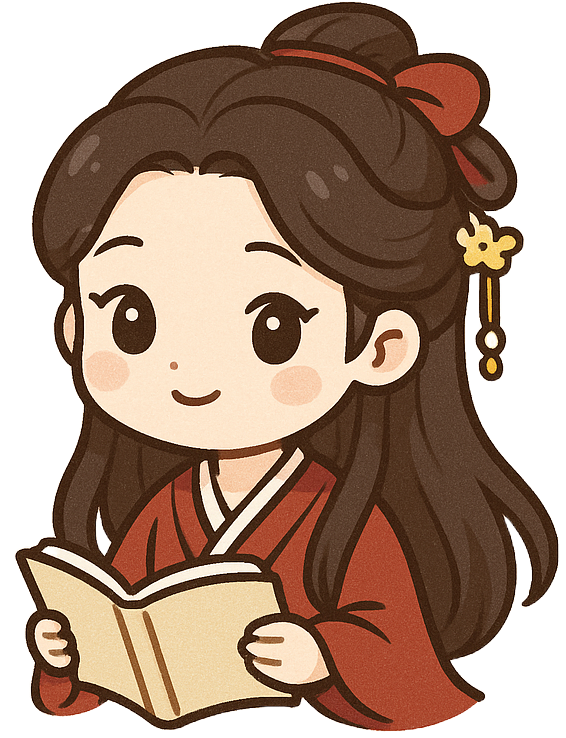
For the next three days, Chen Huan'er became the center of attention, surrounded by Qi Qi and Liao Xinyan wherever she went—the two clung to her so tightly they might as well have formed a conjoined trio even during bathroom breaks. Now that she knew the class monitor's secret feelings, observing their interactions made everything painfully obvious—like how Liao Xinyan would address Song Cong but phrase every question with "you all" as the subject; or how the moment someone complained about the heat, everyone would suddenly get treated to ice cream; or how, at some point, she'd given that bottle of floral-scented mosquito repellent to Jing Qichi, who was equally beloved by mosquitoes, and then beamed with joy for ages over a simple "thanks." Huan'er felt like the designer of an escape room, privy to all the clues and passwords yet forced to watch the players fumble blindly in silence—sometimes frustrated, sometimes amused, but mostly exasperated by that blockhead's obliviousness. Just turn the corner and think a little harder, would you?
On the return bus ride, Huan'er grew carsick. While rummaging for motion sickness pills, Song Cong pulled out the mosquito repellent and raised an eyebrow at Jing Qichi—the guy had always been scatterbrained, stuffing random things into his bag.
Jing Qichi glanced at it and jerked his chin backward. "The monitor's."
"Liao Xinyan," Song Cong called out, tossing it to her without noticing Qi Qi's thunderous expression in the back row.
How did her mosquito repellent end up with Song Cong? The monitor sure knew how to borrow flowers to offer Buddha—flattery by proxy.
She let out an involuntary "hmph," then quickly turned her head to the window to hide her thoughts.
Song Cong handed the pills and water to Huan'er, who sat behind him. Watching her swallow them, he asked, "Want me to tell the teacher to make a stop?"
"No need." Huan'er waved weakly, her face pale.
Jing Qichi braced one knee on his seat, twisting around to hug the headrest. "I'll tell you something that'll cure your nausea."
Huan'er, queasy and half-lidded, managed one word: "Go."
"Song Cong's aiming for Peking University."
Even Liao Xinyan, seated a row away, laughed.
Only he could treat this as breaking news.
Huan'er rolled her eyes. "And?"
The unnamed lake, Boya Pagoda, the Flower God Temple, the statues of Cai Yuanpei and Li Dazhao—once just images in books, now things she'd seen and touched firsthand. For others, these were dreams; for Song Cong, they seemed more like affirmations of resolve.
Jing Qichi pressed on, "I can get into the sports institute. That just leaves you. Let's all go to Beijing together."
"Me?" The girl smirked. "Tsinghua... wouldn't be bad either."
"Chen Huan'er, I swear—" Jing Qichi jabbed her forehead in mock outrage. "You're such a balloon, inflated enough to float into the sky."
She swatted his hand away and crossed her arms, settling in for a nap.
Only the unattainable could be joked about. Everyone did it—the older they grew, the more it became second nature.
That summer, Huan'er spent only a week in Sishui. When leaving, she hugged her grandparents with a sudden urge to cry. Sishui was childhood, a paradise, a life free from worries about the future. But now, she was drifting further away from it and everything it represented. Goodbyes felt like natural laws—like her developing chest, her increasing height, her maturing mind—happening imperceptibly and leaving no room for resistance.
No one truly learns how to say goodbye. What we learn is simply to respect the inevitable.After the semester began, ten students left the class, and twelve new ones were added. The humanities classes were all relocated to the original lab building, separated from the science classes in the main building by the faculty office area. Huan'er had calculated that if she ran out the moment the bell rang, descended three floors, crossed the administrative building garden, and then climbed two more floors to reach Qi Qi's classroom, she could exchange about five sentences before having to rush back to avoid being late. This required Qi Qi to avoid any time-consuming activities like going to the bathroom, fetching water, or discussing problems, and imposed strict limits on the speed and length of their conversation. In short, meeting during breaks was nearly impossible.
Soon after, even lunch and dinner couldn’t be synchronized daily. Delayed classes, pop quizzes, homeroom meetings, or catching up on homework—there was always something more important than eating together.
The only tradition that remained was walking home together after school. That ten-minute journey felt like the last stand against their growing separation.
Huan'er’s new deskmate was Du Man, a long-faced girl with glasses. Apart from asking a few basic questions about the teachers on the first day, she spent most of her time silently buried in books. What left the deepest impression on Huan'er were the black or blue smudges on the outer side of Du Man’s ring and pinky fingers, stains from smudged ink that seemed like some kind of wordless declaration.
Du Man was a boarding student who went home once a week. One Saturday, Huan'er was sent by her mother to buy garlic at the supermarket near their neighborhood. As she checked out, she noticed a father and daughter walking ahead of her. The girl wore skinny jeans, a plaid shirt, and had her hair tied into a small ponytail—her silhouette vaguely resembling Du Man’s. Since everyone usually wore oversized school uniforms, Huan'er wasn’t sure if that slender, tall figure belonged to her deskmate. Given the distance, she didn’t call out. Later, while chatting with her mother, she casually asked if there were any doctors surnamed Du in their compound with kids around her age. Chen Ma thought for a moment and shook her head. "Almost everyone from Tianzhong went to that last summer camp, except for a few seniors… Come on, you three are always swaggering around like you own the place. If she lived here, she’d have definitely said hello by now."
Fair point. Besides, why would anyone choose to board when they lived so close? Huan'er didn’t dwell on it.
There’s actually a long road between being classmates and becoming friends—one that requires time and communication to traverse. This opportunity cost is, in essence, a two-way selection. Needless to say, the college entrance exam doesn’t test friendship, nor will it ever.
For this season’s sports meet, Jing Qichi put in considerable effort to scout the competition from other classes. Applying the principle of "Tian Ji’s Horse Racing," he strategically arranged their team, leading Class Five to a decisive victory. While Lao Xu was pleased, he still scolded Jing Qichi mercilessly. "With a brain like that, why can’t you apply it to your studies? You can’t even write the character 'Ji' in 'Tian Ji'!" Whether it was the constant reprimands finally striking a chord or the summer camp sparking some ambition, Jing Qichi surprised everyone one day when he came over to Huan'er’s house for dinner and borrowed her laptop—only to pull up the admission scores for sports universities over the years. Huan'er was so shocked she immediately took a photo for posterity. Even the usually unflappable Song Cong asked with unusual seriousness, "You’re really considering it?"
"Thinking about it," Jing Qichi replied, looking at them both. "You guys have options—big cities, top schools, average ones, whatever. But me… I’m afraid I won’t get into any school at all."
In the most recent monthly exam, Jing Qichi ranked third from the bottom in their class.
"It won’t be that bad," Huan'er teased. "If you don’t get in, you can just go work in the city. We’ll take care of you."
Jing Qichi grabbed a throw pillow and hurled it at her. Huan'er dodged nimbly and was about to retaliate when Song Cong intercepted it. "How old are you two?""The major isn't much of an issue, and my training condition has improved recently. But these cultural subjects... they're tough."
Choosing a school is like falling for someone—the rose-tinted glasses get thicker over time until everything about it seems perfect. As for the rest, no matter how good they are, they're just substitutes.
Song Cong pondered for a moment. "Chinese and English require time and memorization—don't look for shortcuts, just memorize first. Biology just started, so keeping up shouldn't be a problem. The other subjects... pick one to focus on first."
The implication was clear: You decide, I'm ready whenever.
"Math then. It's worth the most points."
"Alright."
Huan'er threw a pillow at him. "Jing Qichi, I'm lending you my personal tutor. Remember this favor."
"It's me lending you , you ungrateful brat." Jing Qichi rubbed his shoulder. "That hit was like a dose of nitroglycerin—always so rough."
"Want me to give you sodium cyanide instead?"
"Then I'll just drink some hydrogen peroxide."
Huan'er and Song Cong exchanged a glance before bursting into laughter. "Not bad, you even remember chemical formulas now."
"Can't I save myself?" Jing Qichi scoffed at their surprise. "Besides, who doesn't have a doctor at home?"
"My Dream" was an essay topic we wrote about since childhood. It was like a downward curve, mentioned less and less until people could neither write nor speak of it. Adults are far less brave than children—they care about face, fear embarrassment, and are too aware of honor and shame, so they bury more and more in their hearts, growing lonelier with time. At the midpoint of this curve, somewhere between bravery and loneliness, dreams are wrapped in a layer of disguise and shared with close friends. It's an age unafraid of the future yet just learning to be grounded, a bit arrogant yet able to withstand mockery, striving for maturity yet constantly revealing childishness.
Yes, it's an age of contradictions—the best age, one we miss the moment it's gone.